
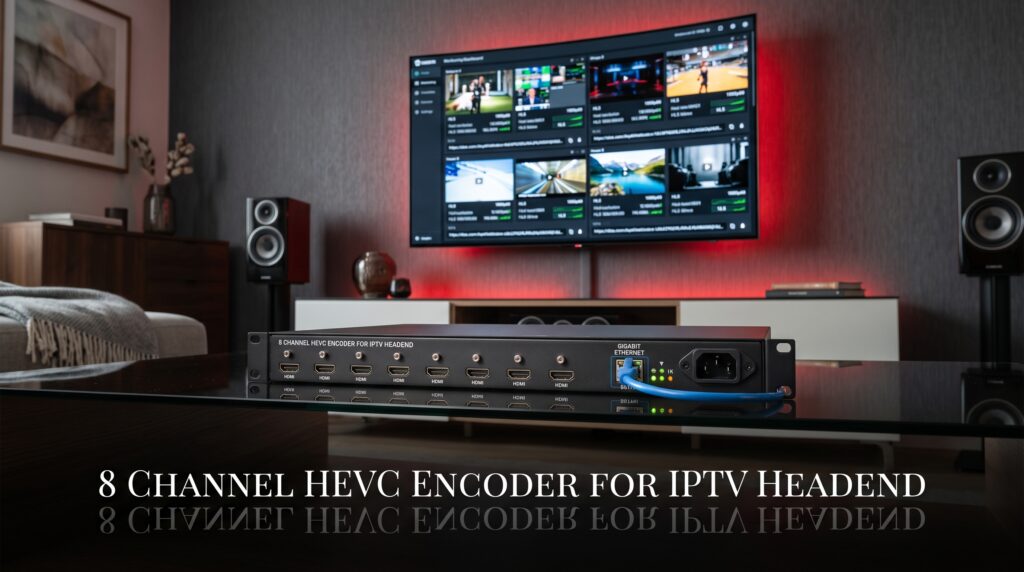
Snippet Summary: An 8 channel HEVC encoder for IPTV headend is a professional-grade broadcasting device designed to capture up to eight separate video inputs (like HDMI or SDI) and compress them using High-Efficiency Video Coding (H.265/HEVC). This crucial piece of hardware empowers service providers to deliver stunning 4K and HD video content over IP networks, utilizing 50% less bandwidth than older legacy encoders to ensure smooth, buffer-free streaming for audiences across the USA and beyond.
The digital broadcasting landscape is undergoing a massive transformation. With consumer demand for flawless 4K streaming and high-definition live television skyrocketing, network engineers and streaming entrepreneurs face a significant technical hurdle.
They must figure out how to deliver pristine, high-resolution video quality without completely overwhelming their server’s network bandwidth. This is exactly where deploying an 8 channel HEVC encoder for IPTV headend becomes an absolute necessity for modern media businesses.
By leveraging advanced mathematical video compression algorithms, these high-density encoding units serve as the structural backbone of contemporary streaming infrastructures. They seamlessly ingest raw, uncompressed video signals and shrink their file size, preparing them for highly efficient internet protocol delivery.
Whether you are running a localized hotel entertainment network or building a commercial streaming empire, relying on outdated H.264 technology will eventually cripple your scalability. In this expert-level guide, we will explore the technical nuances, installation steps, and business ROI of this essential broadcasting hardware.
If you are looking to see top-tier streaming in action, check out the premium services on our Home Page.
To fully grasp the immense value of this networking hardware, we need to break its terminology down into three functional components.
First, the “8 channel” designation means the physical unit can simultaneously capture and process eight independent video feeds. This high-density capability is perfect for standard 1U rack-mounted server environments where physical space is expensive and limited.
Second, “HEVC” stands for High-Efficiency Video Coding, widely recognized in the industry as H.265. This codec is the current global gold standard for video compression. When an 8 channel HEVC encoder for IPTV headend utilizes this modern codec, it processes video files significantly more efficiently than older H.264 legacy standards.
Finally, the “IPTV headend” refers to the master facility or centralized server distribution point where television signals are received, transcoded, and packaged for internet-based distribution.
When combined, these elements create a powerhouse device. An 8 channel HEVC encoder for IPTV headend acts as the central processing brain for your video streams, converting heavy raw data into lightweight, streamable IP packets.
For industry standards on video codecs, you can refer to the comprehensive guidelines published by the Streaming Video Technology Alliance.
For more than a decade, Advanced Video Coding (AVC / H.264) was the undisputed king of internet video streaming. However, as ultra-high-definition 4K and 8K resolutions aggressively entered the consumer market, H.264 simply could not process the massive data weight.
Upgrading your infrastructure with an 8 channel HEVC encoder for IPTV headend fundamentally solves this data payload crisis. The H.265 codec was specifically engineered to deliver the exact same visual fidelity as its predecessor, but at half the required bitrate.
Consider the sheer volume of data required for high-definition streaming. If you broadcast a 4K channel using older H.264 hardware, you typically require a continuous bitrate of about 15 Mbps to 32 Mbps to prevent pixelation. Multiply that heavy load by 8 separate channels, and you are burning through massive amounts of expensive server bandwidth.
When you route those exact same video signals through an 8 channel HEVC encoder for IPTV headend, the necessary bitrate immediately drops to roughly 7 Mbps to 15 Mbps per channel. This massive 50% reduction in data payload directly translates to lower Content Delivery Network (CDN) costs and drastically reduced packet loss.
Beyond the obvious bandwidth savings, HEVC compression handles high-motion video significantly better. Live sports broadcasts and action movies demand high framerates (60fps) and deep color accuracy (10-bit color).
The advanced Coding Tree Units (CTUs) inside an 8 channel HEVC encoder for IPTV headend can process much larger blocks of pixels simultaneously compared to H.264 macroblocks, rendering high-action content flawlessly. For a deep dive into the engineering behind these algorithms, read the technical papers available on IEEE Xplore.
Not all broadcasting hardware is built to the same standards. If you are sourcing equipment for a commercial 24/7 streaming business, you need enterprise-grade hardware that won’t crash under continuous load.
Here are the critical, mandatory features you must look for when purchasing an 8 channel HEVC encoder for IPTV headend.
Your encoding hardware must be fluent in multiple digital networking languages. Ensure your specific device supports a broad spectrum of streaming protocols, including:
UDP/RTP (Multicast): The standard for highly stable, local area networks and ISP closed networks.
HLS (HTTP Live Streaming): The absolute necessity for reaching mobile devices, smart TVs, and web browsers.
RTMP/RTMPS: Essential for pushing live feeds to social media platforms or legacy CDN ingest points.
SRT (Secure Reliable Transport): Crucial for transmitting broadcast-quality video over unpredictable, public internet networks. You can learn more about SRT protocol developments from its creators at Haivision.
Video clarity is only half of the broadcasting equation. A premium 8 channel HEVC encoder for IPTV headend must natively support advanced audio codecs like AAC, MP3, and AC3 digital pass-through.
Furthermore, the management interface should allow for independent audio gain adjustments, enabling you to normalize the volume across all eight channels seamlessly.
You should aggressively avoid software-based encoders for heavy, commercial lifting. You want a dedicated hardware device that features dedicated DSP (Digital Signal Processing) chips.
A hardware-based 8 channel HEVC encoder for IPTV headend guarantees zero CPU throttling, ultra-low latency processing, and zero dropped frames during months of uninterrupted operation.
Professional broadcasters frequently need to overlay custom logos, anti-piracy watermarks, or scrolling text directly onto the live video feed. A top-tier encoder allows you to inject transparent PNG graphics into the HEVC stream without requiring secondary external mixing hardware.
Who actually deploys this level of sophisticated hardware? The operational applications for an 8 channel HEVC encoder for IPTV headend span across multiple multi-million dollar industries in the USA.
Modern luxury hotels are aggressively ditching traditional, analog coaxial cable setups. By installing a high-density encoder, a hotel IT department can capture direct satellite feeds, compress them, and distribute hundreds of crystal-clear channels directly to smart TVs in guest rooms over their existing Ethernet infrastructure.
Regional ISPs that bundle digital television packages alongside their high-speed fiber internet rely entirely on HEVC compression technology. Using an 8 channel HEVC encoder for IPTV headend allows these providers to pack significantly more HD channels into a smaller fiber pipe, maximizing their service offerings.
Massive sports bars and entertainment venues use HEVC encoders to distribute live camera feeds or specific sporting events to dozens of monitors simultaneously. The low-latency processing ensures that the visual feed on the screen perfectly matches the real-time action, keeping patrons highly engaged.
Once you have finally unboxed your new broadcasting equipment, getting it properly configured requires a methodical, expert approach. Follow these structured steps to ensure optimal, long-lasting performance.
Mount the device securely in your IT rack, ensuring there is at least 1U of empty, ventilated space above and below it. HEVC encoding requires intense mathematical processing, which generates considerable heat. Connect your 8 HDMI or SDI video source inputs, plug in your primary Gigabit LAN cable, and boot the unit up.
Enterprise encoders do not rely on physical screens for configuration. You will manage your 8 channel HEVC encoder for IPTV headend strictly via a local web browser. Locate the default IP address (often 192.168.1.168), set your laptop to the corresponding subnet, and log into the administrative dashboard.
Navigate directly to the “Video Settings” or “Encoding” tab. Select “H.265/HEVC” as your primary codec. For standard 1080p 60fps content, configure your Variable Bitrate (VBR) to roughly 4500 kbps to 6000 kbps. If you are broadcasting in True 4K, adjust the bitrate closer to 12000 kbps for optimal clarity.
Move to the “Network Output” section of the dashboard. If you are distributing to a local closed network, enable UDP Multicast and assign a unique IP address (e.g., 239.1.1.1) to each channel. If you are pushing the streams to a global server, input your SRT or RTMP destination URLs.
Once configured, your system is ready to deliver premium content. Curious about what premium delivery looks like? Get Your 24H Trial Here and test our infrastructure for yourself.
For business owners and network administrators, purchasing professional broadcasting hardware is not merely an operational necessity; it is a highly strategic financial investment.
Let’s examine the hard economic logic. If your commercial streaming operation pays for outbound CDN bandwidth by the terabyte, cutting your overall data payload by 50% immediately halves your monthly distribution expenses.
Furthermore, utilizing a high-density 8-in-1 device drastically reduces expensive data center rack space and power consumption. Instead of running eight separate, power-hungry 1U encoders, you consolidate everything into a single, highly efficient 8 channel HEVC encoder for IPTV headend.
The subsequent reduction in commercial electricity and server cooling costs alone will frequently offset the initial purchase price of the hardware within the first 12 to 14 months of deployment.
Are you looking to see how these savings translate into consumer pricing? Check Our Pricing Plans to see highly competitive, market-leading subscription options.
Even with the highest quality, enterprise-grade hardware, network engineers will occasionally encounter streaming anomalies. Here are the most common technical issues associated with an 8 channel HEVC encoder for IPTV headend and how to resolve them rapidly.
If your end-users are complaining about endless buffering rings, your encoder’s output bitrate is almost certainly exceeding the capacity of your viewer’s internet connection or your network switch. Log into your dashboard and lower the maximum bitrate cap by 15%. Additionally, verify that your core network switches have IGMP Snooping enabled.
Audio drift is a notorious and frustrating issue in 24/7 live broadcasting. This typically occurs when the HDMI input source provides an irregular framerate. Check the audio settings within your 8 channel HEVC encoder for IPTV headend, ensure the audio sample rate is hard-coded to 48000 Hz, and enable “PTS Sync” (Presentation Time Stamp) if available.
If your administrative dashboard displays internal CPU temperatures exceeding 80°C, your device is at severe risk of thermal throttling. Ensure the cooling fans on your 8 channel HEVC encoder for IPTV headend are unblocked, and verify that your server room’s HVAC system maintains an ambient temperature consistently below 72°F (22°C).
Digital streaming technology advances at a staggering, relentless pace. While HEVC/H.265 is currently the dominant, undisputed force in the industry, smart network engineers are always planning for the next phase of expansion.
When your subscriber base grows, you will inevitably need to scale up your channel offerings. Fortunately, integrating a second or third 8 channel HEVC encoder for IPTV headend into your server rack is a seamless process. Because these devices output standardized IP streams, you simply plug the new encoder into your core gigabit switch, configure the new IP multicast addresses, and instantly double your channel lineup.
By future-proofing your headend architecture right now with high-density HEVC equipment, you actively prevent the nightmare scenario of an emergency “rip-and-replace” upgrade when higher resolution formats eventually become the mandatory consumer standard.
Building a highly reliable, massively scalable, and incredibly cost-effective streaming infrastructure requires making intelligent, forward-thinking hardware decisions. Older legacy systems are rapidly becoming obsolete, simply unable to handle the crushing data requirements of modern high-definition broadcasting.
By fully integrating an 8 channel HEVC encoder for IPTV headend into your core network design, you are guaranteeing superior video quality, achieving massive bandwidth savings, and providing a flawless viewing experience for your audience. From multi-protocol IP outputs to dedicated hardware DSP processing, these advanced units are the ultimate solution for professional video delivery.
Don’t let outdated compression codecs bottleneck your business growth and frustrate your subscribers. It is time to upgrade your headend hardware, deeply optimize your network traffic, and deliver the pristine 4K quality your audience demands.
Ready to revolutionize your streaming experience? Head over to our Home Page to explore our top-tier services, Check Our Pricing Plans to find a package that fits your needs, or Get Your 24H Trial Here to experience buffer-free, high-definition HEVC streaming right now!
67iptv © 2026 all rights reserved
WhatsApp us