
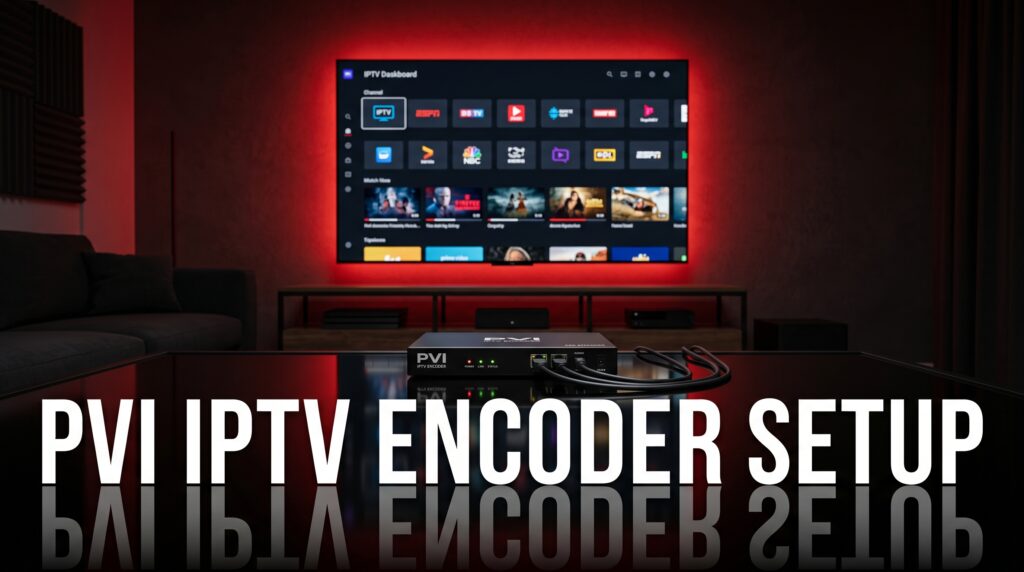
Snippet Summary: What is the correct way to configure professional broadcasting hardware? A flawless pvi iptv encoder setup is the critical technical process of physically connecting your raw video source to a dedicated ProVideoInstruments (PVI) hardware encoder, configuring the internal digital network settings, and transmitting a highly compressed, ultra-low latency IP video stream directly to a global server. By mastering this exact hardware configuration, professional broadcasters completely eliminate stream buffering, prevent audio desynchronization, and securely deliver stunning 4K live television over standard internet connections.
If you are a serious digital entrepreneur, a professional broadcaster, or a systems integrator operating in the United States, you understand that reliable video transmission is everything. During your extensive research to build a robust live streaming ecosystem, you have likely realized that mastering the pvi iptv encoder setup is the absolute most critical technical milestone in your entire project.
If you fail to configure this expensive enterprise hardware correctly, your audience will suffer from severe latency, massive pixelation, and total server dropouts during major live events. In today’s fiercely competitive digital media landscape, amateur broadcasting setups simply do not survive. You cannot rely on fragile desktop software running on an overheating computer.
You require dedicated, industrial-grade encoding technology. However, navigating the highly complex web interfaces and network protocols of enterprise equipment can be incredibly overwhelming for newcomers. In this incredibly detailed, expert-level guide, we are going to completely demystify the entire configuration process.
We will walk you through the physical cable connections, the precise web dashboard configurations, and the advanced digital protocols required for a perfect pvi iptv encoder setup. By the end of this extensive technical breakdown, you will possess the expert knowledge required to build, deploy, and scale a completely freeze-free digital broadcasting network.
A PVI (ProVideoInstruments) encoder is an industrial-grade piece of broadcasting hardware designed specifically for heavy video compression and 24/7 live streaming.
Unlike standard computer software, a dedicated hardware encoder performs only one job: mathematically processing video.
A proper pvi iptv encoder setup allows users to seamlessly stream:
Live 4K professional sports events
24/7 independent television channels
Corporate keynote presentations
House of worship services
High-speed gaming tournaments
Modern hardware encoders are built for ultimate convenience and uncompromised stability. You can push your live content globally with a stable internet connection.
For a deeper understanding of the video compression mathematics behind this hardware, visit the official High Efficiency Video Coding (HEVC) guide on Wikipedia.
The popularity of dedicated broadcasting hardware continues to grow rapidly in the USA and worldwide.
Relying on a standard laptop to encode video is dangerous because computers easily overheat and crash during live broadcasting events.
Mastering your pvi iptv encoder setup completely removes the fragile computer from your broadcasting equation.
1. Unmatched System Stability
Computers run background updates and get distracting notifications. A dedicated hardware encoder runs quietly for months without crashing.
2. Superior Video Compression
A successful pvi iptv encoder setup guarantees access to the absolute latest compression codecs on the market.
These modern codecs include:
H.264 (Advanced Video Coding)
H.265 (High-Efficiency Video Coding)
AAC Advanced Audio processing
MP3 Digital Audio embedding
3. Ultra-Low Latency Broadcasting
A high-quality PVI encoder pushes video frames in mere milliseconds.
This ultra-low latency is absolutely critical for:
Live football matches
Interactive corporate webinars
Live global auctions
Breaking news reports
Pay-per-view UFC events
4. SRT Protocol Support
Many networking professionals execute a pvi iptv encoder setup strictly to gain access to SRT (Secure Reliable Transport).
SRT prevents stream dropouts even if your local internet connection fluctuates heavily.
5. Seamless Multicasting Capabilities
Enterprise environments often need to send one video feed to hundreds of local televisions simultaneously.
A proper pvi iptv encoder setup allows you to push UDP multicast streams effortlessly across:
Luxury hotel networks
Massive university campuses
Large corporate offices
Hospital waiting rooms
Massive sports bars
Not every piece of equipment delivers the exact same quality. Choosing the wrong accessories can completely ruin your stream.
Here are the most important hardware items to gather before you begin your pvi iptv encoder setup.
Premium HDMI or SDI Cables
A pristine pvi iptv encoder setup requires high-speed cables to prevent sudden signal loss.
Your video cables must boldly support:
4K resolution at 60fps
High Dynamic Range (HDR)
Heavy shielding against radio interference
Secure locking mechanisms (like SDI BNC connectors)
A Gigabit Network Switch
Never plug your professional enterprise encoder directly into a cheap, overloaded home router.
You need a dedicated unmanaged Gigabit switch to safely handle the massive data packets seamlessly.
A Professional Video Switcher
If you use multiple live cameras, you must carefully route them through a switcher (like an ATEM Mini) first.
Then, you safely run a single HDMI or SDI cable directly into your PVI hardware.
With so many settings available, configuring your hardware can feel slightly confusing for broadcasting beginners.
Here is the exact step-by-step process to complete your pvi iptv encoder setup successfully.
Step 1: The Physical Connections
The physical connections heavily dictate the baseline stability of your entire broadcast.
Plug your primary camera into the HDMI or SDI Input port.
Connect the Cat6 Ethernet cable from the encoder to your network switch.
Plug in the official 12V PVI power supply.
Wait for the network lights to begin flashing green rapidly.
Step 2: Finding the IP Address
Your PVI encoder operates independently, meaning it does not have a physical viewing screen.
To continue your pvi iptv encoder setup, you must access its internal web dashboard.
Log securely into your local internet router.
Look closely at the list of connected DHCP devices.
Find the IP address assigned specifically to the PVI unit.
Type that specific IP address directly into your Google Chrome browser.
Step 3: Configuring the Video Bitrate
Once securely logged into the dashboard, you must firmly set your target video bitrate.
Bitrate mathematically determines the overall visual quality of your live stream.
For static talk shows: Set the bitrate to 4 Mbps.
For fast-paced sports: Set the bitrate to 12 Mbps.
For pristine 4K gaming: Set the bitrate to 20 Mbps.
Step 4: Choosing the Streaming Protocol
Your pvi iptv encoder setup actively requires a specific digital language to safely speak to the internet.
Select RTMP if streaming to YouTube or Facebook Live.
Select SRT if streaming to a private, high-end global server.
Select UDP if multicasting to local televisions in your building.
You can also deeply explore our complete streaming panel options right here:
Explore our flexible premium pricing plans
Streaming quality depends incredibly heavily on your local internet upload speed.
A truly flawless pvi iptv encoder setup strictly requires adherence to these baseline recommendations.
| Streaming Quality | Minimum Upload Speed | Recommended Upload Speed |
| 720p HD Streaming | 5 Mbps | 10 Mbps |
| 1080p Full HD Streaming | 10 Mbps | 20 Mbps |
| 4K Ultra HD Streaming | 25 Mbps | 50+ Mbps |
| Multi-Stream Broadcasting | 40 Mbps | 100+ Mbps |
A hardwired Ethernet connection always provides significantly better stability than a wireless Wi-Fi connection.
You can strictly verify national broadcasting standards and infrastructure requirements here:
A professionally executed pvi iptv encoder setup consistently offers several distinct technical advantages compared to standard software encoding.
Zero Thermal Throttling
Hardware encoders are safely wrapped in aerospace-grade aluminum chassis.
This acts as a giant physical heat sink, allowing the device to run 24/7 without melting or pausing.
Dedicated Audio Embedding
Video without perfectly synced, crystal-clear audio is completely unwatchable.
Your pvi iptv encoder setup seamlessly allows you to inject audio directly from a mixing board via the 3.5mm line-in jack.
Sub-Stream Capabilities
Modern PVI hardware safely allows you to push two completely different video streams simultaneously.
Main Stream: Pushes pristine 4K video to your main broadcasting server.
Sub Stream: Pushes compressed 720p video to a mobile smartphone application.
Even the absolute best hardware platforms may occasionally experience minor digital configuration issues.
If your pvi iptv encoder setup is currently failing, quickly check these common problems.
Severe Stream Buffering
If your viewers are constantly seeing a frustrating loading circle, your network is mathematically bottlenecking.
Possible causes include:
Your video bitrate is set much higher than your internet upload speed.
You are actively using an outdated, damaged Cat5 Ethernet cable.
Your local ISP is aggressively throttling your connection.
Fix: Quickly lower your H.265 bitrate by 2 Mbps and securely reboot the hardware.
Audio and Video Desynchronization
Sometimes the speaker’s lips naturally move, but the digital audio arrives two seconds later.
Possible causes include:
The camera’s internal processing is far too slow.
You selected the wrong audio sampling rate in the PVI dashboard.
Fix: Always ensure your audio settings are safely locked to 48000 Hz AAC within your pvi iptv encoder setup dashboard.
Cannot Access the Web Dashboard
If you physically type the IP address into your browser and absolutely nothing happens, you have an IP conflict.
Possible causes include:
The router automatically reassigned the IP address to someone’s smartphone.
Your computer is actively sitting on a completely different subnet mask.
Fix: Always meticulously assign a Static IP address to your encoder to completely prevent network confusion.
The American digital entertainment industry is actively evolving incredibly quickly.
Consumers and professional broadcasters now heavily prefer:
Flawless 4K live streaming
Zero buffering during massive live events
High-framerate sports coverage
Instant digital video playback
This massive cultural shift confidently explains why mastering a pvi iptv encoder setup is so highly requested by modern media entrepreneurs.
Streaming technology also continuously mathematically improves with:
Faster fiber-optic internet upload speeds
Better H.265 compression mathematics
Cloud-based video delivery networks
AI-powered bandwidth management systems
The digital future of independent live broadcasting looks fundamentally stronger than ever before.
Before you confidently leave your hardware running permanently, keep these expert tips firmly in mind.
Choose Stability Over Maximum Bitrate
Some inexperienced broadcasters blindly push 30 Mbps streams just because their hardware allows it.
A completely stable, flawless 10 Mbps stream is always infinitely better than a crashing 30 Mbps stream.
Test Your Network Before Buying Long-Term Servers
Before publicly launching a massive television network, aggressively test your local infrastructure.
Start with:
Running continuous 24-hour network ping tests
Monitoring core router CPU usage
Testing live stream health on multiple devices
Avoid paying for incredibly expensive streaming panels if your local upload speed is fundamentally broken.
Keep the Hardware Cool
Never carelessly stack multiple hot networking devices directly on top of your premium encoder.
Ensure your pvi iptv encoder setup always includes proper physical ventilation and dedicated airflow.
Finding the right hardware can completely transform and vastly improve your live streaming experience.
The absolute best broadcasting environments seamlessly combine:
Stable enterprise servers
Hardware-based video compression
High-speed Gigabit networks
Premium shielded cabling
Expert technical support
As digital streaming technology continues heavily growing across the globe, dedicated hardware is firmly becoming the standard solution in the USA.
Whether you are a sports broadcaster, a corporate media director, or simply looking for a better way to distribute video, learning the pvi iptv encoder setup offers immense technological value that computer software cannot easily match.
Is a hardware encoder truly better than OBS Studio?
Yes. While OBS is a fantastic free tool, it heavily relies on Windows or Mac operating systems which are highly prone to sudden updates, background tasks, and thermal crashing during long broadcasts. A hardware encoder never crashes.
Do I need a separate encoder for every single camera I own?
If you safely own a professional video switcher, you do not. You can run all your cameras directly into the switcher, and simply route the final mixed feed into your single pvi iptv encoder setup.
Can I realistically use Wi-Fi for my encoder?
We strictly advise against it. Wi-Fi signals inherently suffer from massive packet loss and radio wave interference. Always firmly use a hardwired Cat6 Ethernet cable for your pvi iptv encoder setup to guarantee absolute stability.
What is the absolute best protocol for my stream?
If your destination streaming platform strictly supports it, SRT (Secure Reliable Transport) is the undisputed modern standard. It is vastly superior to the deeply outdated RTMP protocol because it natively handles lost data packets.
Ready to safely launch your broadcasting empire?
If you have successfully configured your enterprise hardware and actively need a highly reliable server to distribute your pristine video to the world, our enterprise infrastructure is waiting.
Visit our Contact Us page today to securely connect your newly optimized encoder to a premium global streaming network!
67iptv © 2026 all rights reserved
WhatsApp us