
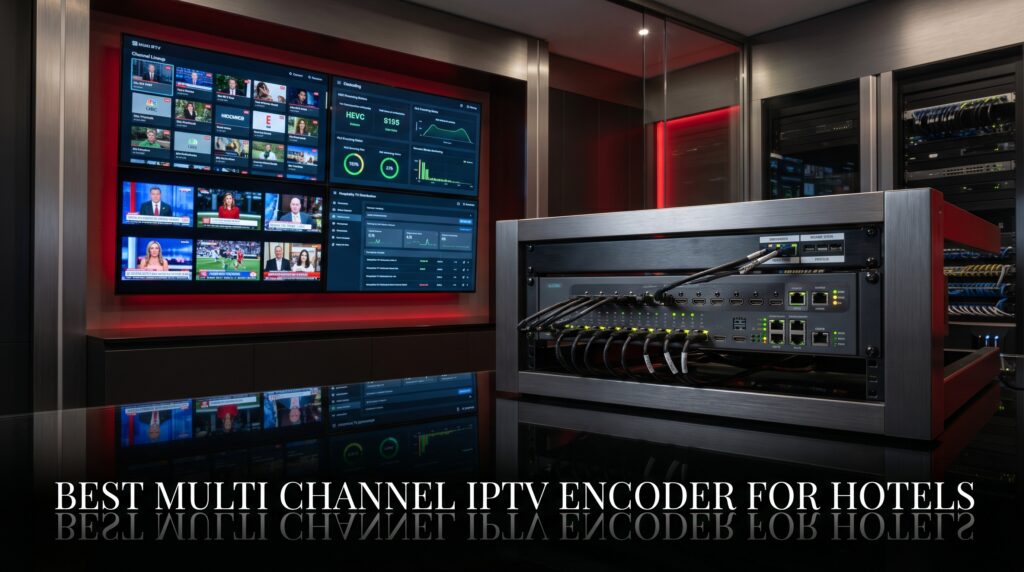
Snippet Summary: The best multi channel iptv encoder for hotels is a high-density, hardware-based headend device that compresses multiple physical video inputs (such as HDMI or SDI from satellite or cable receivers) into efficient digital IP streams like H.264 or H.265/HEVC. This centralized device allows hospitality properties to distribute crystal-clear, high-definition live TV channels directly to thousands of guest room Smart TVs over their existing Ethernet infrastructure, eliminating expensive, outdated analog coaxial systems.
The expectations of hotel guests have changed dramatically over the last few years. When business travelers and vacationers check into a modern property, they no longer tolerate fuzzy, low-resolution television screens. They expect an in-room entertainment system that rivals or exceeds what they have in their own living rooms.
For hotel property managers and hospitality IT engineers, meeting this demand requires an overhaul of traditional distribution methods. Distributing content over legacy analog coaxial cables is no longer viable for high-definition streaming. This technical shift is exactly why deploying the best multi channel iptv encoder for hotels has become a vital operational priority.
A commercial encoder acts as the primary link between your incoming entertainment sources and your property’s internal network infrastructure. It transforms raw video data into lightweight, packetized digital streams. These streams travel effortlessly through your local area network (LAN) directly to the television screens in every guest suite.
Investing in high-density distribution hardware prevents network congestion while ensuring beautiful picture quality. In this comprehensive, expert-level guide, we will break down the essential technical features, network designs, and strategic advantages of selecting top-tier encoding equipment for your property.
If you are looking to see premium, buffer-free live streaming infrastructure in action, explore the solutions on our Home Page.
To understand why specific hardware is labeled the best multi channel iptv encoder for hotels, we must look at how a hospitality headend room operates. Unlike a home streaming setup that handles a single video feed, a hotel headend must process dozens or hundreds of channels simultaneously.
A multi-channel encoder packs several independent processing cores into a compact, space-saving 1U or 2U rackmount server shell. Each input channel inside the device captures a live video signal from a source—such as a commercial satellite receiver, a media player, or a local marketing camera.
The encoder instantly processes these raw feeds, applies heavy mathematical compression formulas, and outputs a continuous stream of digital IP data packets. These packets are routed through the hotel’s core network switches directly to user endpoints without any noticeable latency.
Choosing the best multi channel iptv encoder for hotels means finding a unit that can handle 8, 16, or 24 physical inputs within a single piece of hardware. This high-density architecture reduces power consumption, minimizes hardware failures, and saves premium space inside your property’s central server room.
For deeper insights into emerging digital video distribution frameworks, consult the updated technical archives of the Streaming Video Technology Alliance.
Selecting the wrong hardware for a commercial property can lead to constant system crashes, freezing screens, and frustrated guest complaints. When evaluating your equipment options, you must ensure the unit includes enterprise-grade specifications built for 24/7 continuous operation.
The best multi channel iptv encoder for hotels must support both H.264 (AVC) and H.265 (HEVC) compression codecs. While H.264 offers universal compatibility with older legacy hospitality TVs, HEVC is the gold standard for modern 4K installations.
HEVC compresses video files up to 50% more efficiently than H.264. This means you can distribute pristine 1080p and 4K channels across your hotel rooms using half the network bandwidth, preventing your property’s administrative internet from slowing down during peak viewing hours.
Your centralized encoding hardware must be capable of translating video into various internet protocol languages simultaneously. The best multi channel iptv encoder for hotels should support the following critical streaming protocols:
UDP / RTP Multicast: The absolute standard for local hotel networks, allowing a single video stream to reach thousands of rooms simultaneously without multiplying bandwidth consumption.
HLS (HTTP Live Streaming): Crucial if your property allows guests to stream hotel TV channels directly onto their personal smartphones, tablets, or laptops while lounging by the pool.
SRT (Secure Reliable Transport): Essential if your property receives video feeds from a remote sister property over the open internet. Learn more about the open-source SRT protocol directly from the Haivision SRT Hub.
Never deploy a software-based encoder running on a standard consumer operating system for a hotel environment. The best multi channel iptv encoder for hotels utilizes dedicated, industrial hardware Digital Signal Processors (DSP).
Hardware-based encoding chips ensure that the intense mathematical calculations required for video compression are handled by isolated silicon components. This architecture prevents system overheating, guarantees ultra-low processing latency, and ensures the encoder operates smoothly for years without needing a manual reboot.
Before purchasing your new headend equipment, you must analyze your incoming video sources. The best multi channel iptv encoder for hotels must physically match the output connections of your content providers’ set-top boxes.
HDMI is the most common interface found in hospitality setups. Commercial satellite providers (such as DIRECTV or DISH Network) supply multi-tuner boxes that output uncompressed video via standard HDMI cables. An 8-channel or 16-channel HDMI encoder connects directly to these source boxes, making installation straightforward and highly compatible.
In some advanced configurations, the best multi channel iptv encoder for hotels will feature built-in RF tuners instead of HDMI ports. These specialized devices ingest raw satellite or terrestrial coaxial cables directly from the roof antenna. The encoder demodulates, decrypts, and encodes the video inside a single chassis, eliminating the need for external satellite boxes entirely.
If your luxury resort features an internal production studio for broadcasting live events, golf tournaments, or corporate conferences across the property, you may require SDI (Serial Digital Interface) inputs. SDI cables feature locking BNC connectors, which prevent accidental disconnections inside busy server racks and support long cable runs without signal degradation.
Even if you purchase the best multi channel iptv encoder for hotels, your installation will fail if your local area network isn’t configured to handle high-density video traffic. Live video data behaves completely differently than standard web browsing traffic.
When a guest turns on their television and selects a channel, the encoder sends that specific channel’s data packets across the network. If your managed network switches are poorly configured, they will broadcast that video data to every single connected device on the property, completely flooding your network.
To prevent this, your network engineers must enable IGMP Snooping (Internet Group Management Protocol) on all core and edge switches. IGMP snooping ensures that the video packets from the best multi channel iptv encoder for hotels are only delivered to the specific guest room TV that requested the channel. This simple setting keeps your administrative networks clean and fast.
To ensure flawless operation, you must calculate your maximum network load before launch. If you encode 24 channels in high-definition H.264, each channel will require roughly 6 Mbps of continuous bandwidth.
Because this data travels exclusively within your local internal network, it does not consume your public internet data. A modern gigabit (1000 Mbps) hotel network can easily handle this load, leaving plenty of room for guest Wi-Fi access.
To verify your property’s overall network speeds and latency baselines, you can run a diagnostic test at Speedtest by Ookla.
Once your equipment arrives, executing a clean, structured installation process is critical to avoiding post-launch technical bugs. Follow this technical walkthrough to deploy your property’s hardware effectively.
Securely bolt your multi-channel encoder into a standard 19-inch server rack. Because these heavy-duty processors operate 24/7, ensure your server room features active HVAC cooling. Maintain an ambient room temperature below 72°F (22°C) to prevent thermal throttling. For official server room environmental standards, review the cooling documentation on PCMag’s infrastructure guide.
Connect your HDMI or SDI source cables from your satellite receivers into the input ports of the best multi channel iptv encoder for hotels. Connect a high-quality Cat6 or Cat7 Ethernet cable from the encoder’s dedicated “DATA” port directly into your core managed network switch.
Open a web browser on a laptop connected to the same network subnet. Enter the factory-default IP address of your encoder into the URL bar to log into the administrative interface. Change the default administrative password immediately to secure your broadcasting infrastructure from unauthorized internal access.
Navigate to the channel configuration dashboard. Select your preferred compression codec (H.264 or H.265). Set the resolution to match your source (e.g., 1920x1080p at 60fps). For optimal stability, configure the bit rate mode to Constant Bitrate (CBR) and set the video bit rate between 4000 kbps and 6000 kbps per channel.
Assign a unique IP multicast address to each of your 8, 16, or 24 channels within the dedicated local multicast range (typically 239.1.1.1 through 239.1.1.24). Set the streaming port to 1234. Save your configuration settings and initiate a soft reboot on the system.
Once your physical headend infrastructure is fully optimized, you will need a world-class IPTV stream delivery partner to feed your channels. You can instantly test high-performance streaming channels on your new hardware by requesting a 24H Trial.
Even with premium equipment installed, hospitality IT managers will occasionally run into system anomalies. Here is how to diagnose and resolve the most common issues associated with a high-density encoder deployment.
If guests report that the television screen breaks into digital blocks during high-action scenes, your encoder’s bitrate is set too low for the resolution. Log into your best multi channel iptv encoder for hotels dashboard and increase the video bitrate by 1000 kbps. If the pixelation persists, check your source HDMI cables for physical damage or loose connections.
If a channel runs smoothly for a few minutes and then freezes completely, your network switches are likely dropping data packets. This occurs when IGMP Snooping is turned off, causing a data loop. Verify that an IGMP Querier is active on your core switch to manage the multicast traffic flow cleanly.
If the actors’ voices do not match their lip movements on the guest room TVs, the encoder is struggling to align the incoming audio and video timestamps. To fix this, access your encoder’s audio management tab, hard-set the audio sampling rate to a locked 48000 Hz, and switch the audio codec format to AAC-LC.
For hotel owner-operators and corporate hospitality executives, upgrading to the best multi channel iptv encoder for hotels is an investment that provides immediate, tangible financial returns.
First, consolidating your headend infrastructure saves significant physical space. Older systems required a massive bank of individual single-channel modulators that filled multiple server racks. A modern multi-channel encoder packs up to 24 channels into a single 1U slot, dramatically lowering your data center real estate costs.
Second, modern hardware encoders consume significantly less electricity and generate far less heat than legacy equipment. By switching to an efficient best multi channel iptv encoder for hotels, a mid-sized 300-room property can reduce its monthly utility and server room cooling costs by thousands of dollars annually.
Finally, digital IP video distribution eliminates the need to maintain expensive, specialized coaxial cabling networks. Because the video travels over your existing corporate Ethernet network, a single IT team can manage both the guest Wi-Fi and the television system simultaneously, reducing third-party maintenance contracts.
To see how these backend operational savings translate into competitive, budget-friendly consumer entertainment packages, review our official Pricing Plans.
As we look toward the future of hotel entertainment, technology continues to move toward deeper personalization. Modern guests expect their room’s TV to integrate seamlessly with their personal streaming accounts, property management systems, and room service apps.
The best multi channel iptv encoder for hotels acts as the foundation for these interactive middleware platforms. Because the encoder outputs clean, standardized digital IP streams, hospitality developers can easily overlay interactive menus, digital hotel room service menus, and local tourism guides directly on top of the live broadcast channels.
Furthermore, as artificial intelligence chips become integrated into next-generation encoder models, we will soon see hardware that automatically alters compression bitrates based on the specific type of content being watched, lowering data consumption during news broadcasts and boosting processing power during live sporting events.
Upgrading your hospitality property’s television infrastructure is no longer a luxury—it is a critical requirement for maintaining high guest satisfaction scores and staying competitive in the modern travel market.
By strategically selecting and deploying the best multi channel iptv encoder for hotels, you ensure that your property delivers pristine, low-latency, high-definition entertainment to every room on your property without overloading your local networks. From advanced HEVC compression to robust hardware reliability, investing in commercial-grade encoding equipment is the ultimate solution for modern properties.
Don’t let an outdated, blurry television system generate negative reviews for your hotel. It’s time to future-proof your headend room, streamline your internal data management, and provide the luxury viewing experience that your guests deserve.
Ready to transform your hotel’s entertainment infrastructure?
Explore our full suite of premium streaming solutions by visiting our Home Page. If you are ready to evaluate our channel packages for your property, check out our flexible Pricing Plans, or instantly verify our stream stability with a risk-free 24H Trial today. Have a question about configuring your hotel network? Leave a comment below, and our engineering team will help you out!
67iptv © 2026 all rights reserved
WhatsApp us