
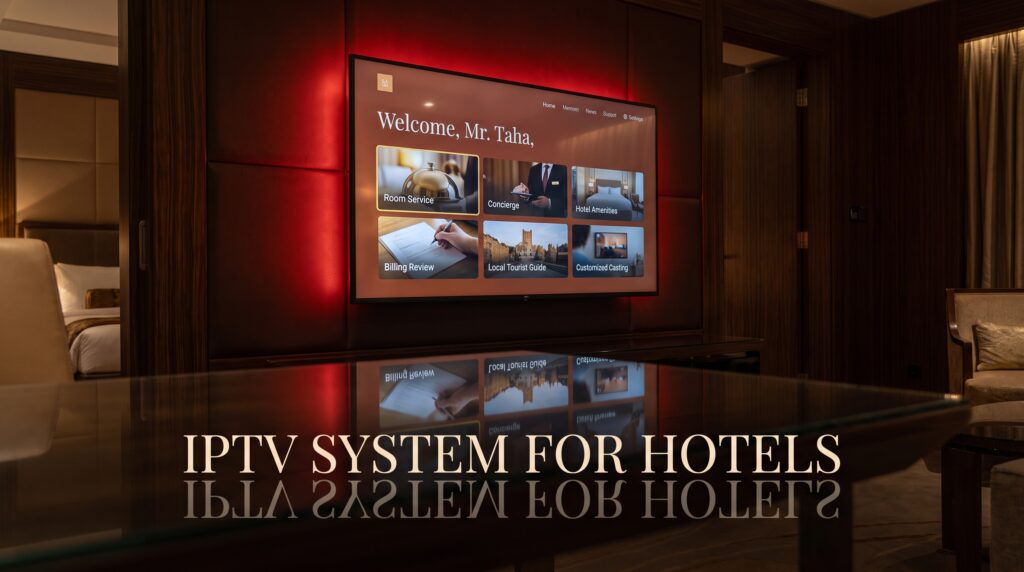
Snippet Summary: An iptv system for hotels is an enterprise-grade digital broadcasting solution that delivers live television, on-demand movies, interactive guest services, and customized hotel branding over a property’s local IP network. Unlike legacy coaxial cable setups, an iptv system for hotels integrates directly with Property Management Systems (PMS) to provide personalized welcome screens, room service ordering, express checkout, and seamless casting capabilities directly on guest room smart TVs.
The modern hospitality industry is undergoing a massive technological transformation. Today’s travelers expect the same seamless, high-definition entertainment experiences in their hotel rooms that they enjoy at home.
Traditional coaxial cable networks and rigid satellite TV packages no longer meet the expectations of tech-savvy guests.
Deploying a state-of-the-art iptv system for hotels has become a critical requirement for hotel owners, general managers, and IT directors looking to boost guest satisfaction scores while streamlining operational costs.
If your property is still relying on legacy cable infrastructure with limited channel selections, slow navigation, and zero interactive features, you are missing out on significant revenue opportunities.
In this comprehensive expert guide, we will explore how an iptv system for hotels works, its primary features, technical architecture, cost advantages, and how to select the ideal deployment strategy for your property in 2026.
To appreciate why top-tier hospitality brands are upgrading their media infrastructure, it is essential to understand how an iptv system for hotels operates under the hood.
Unlike traditional broadcasting, which transmits analog or digital signals over copper coaxial cables, Internet Protocol Television uses local area networks (LAN) to stream digitized media packets.
At the core of every commercial iptv system for hotels is the IPTV headend and middleware server.
The headend receives satellite, terrestrial, or IP streams from content aggregators, decrypts the video channels, encodes them into standardized IP streams (such as H.264 or HEVC/H.265), and distributes them across the hotel’s network switches.
The middleware acts as the operational brain, controlling the graphical user interface (GUI), channel package authorization, guest messaging, and digital signage displays.
For a deeper technical breakdown of enterprise video streaming protocols, you can consult the official Internet Protocol Television overview on Wikipedia.
Data packets travel across the hotel’s structured Category 6 (Cat6) ethernet wiring or Fiber-to-the-Room (FTTR) network.
At the endpoint, smart TVs (such as commercial LG webOS or Samsung Tizen hospitality displays) or dedicated set-top boxes (STBs) decode the streams and render the interactive portal.
Because the entire network operates on standard IP hardware, managing content across hundreds of rooms becomes centralized, efficient, and instantly customizable.
The expectations of hotel guests have changed dramatically over the last decade. Travelers no longer sit down to watch linear television according to a fixed broadcast schedule.
Implementing a modern iptv system for hotels aligns your property’s amenity offering with contemporary consumer habits.
When a guest enters their room, the in-room television is often the first visual device they interact with.
An iptv system for hotels creates a memorable first impression by displaying a personalized welcome screen featuring the guest’s name, local weather forecasts, hotel announcements, and customized ambient background music.
Providing high-definition channel packages, crystal-clear 4K video-on-demand, and reliable mobile device casting leads directly to higher online review ratings and elevated net promoter scores (NPS).
One of the most powerful aspects of an iptv system for hotels is its ability to communicate directly with your Property Management System (PMS) such as Oracle Opera, Protel, or Cloudbeds.
This integration allows guests to perform various operational tasks directly from their TV screen:
View real-time room folio billing charges
Request room cleaning or extra towels
Order room service from an interactive visual menu
Complete express check-out without waiting at the front desk
To learn more about how flexible enterprise streaming models operate across various environments, visit our main 67IPTV homepage today.
When evaluating vendor options for your property, you must ensure the platform offers enterprise-grade capabilities tailored to hospitality standards.
Here are the key features that every modern iptv system for hotels should incorporate.
Your in-room entertainment system should serve as an extension of your hotel’s brand identity.
A high-quality iptv system for hotels allows administrators to design custom TV layouts incorporating property logos, corporate color schemes, promotional banners, and localized event calendars.
Whether operating a boutique hotel, a luxury resort, or a commercial airport hotel, the interface can be tailored to match your specific market positioning.
Modern travelers carry smartphones, laptops, and tablets pre-loaded with personal streaming apps like Netflix, YouTube, Hulu, and Spotify.
An advanced iptv system for hotels incorporates secure isolation protocols (such as Google Chromecast for Hospitality or Apple AirPlay integration).
This enables guests to pair their personal mobile devices to the in-room TV with a single QR code scan, allowing them to stream their own subscription content safely without exposing sensitive login credentials to future guests.
International guests require intuitive navigation in their native languages.
A professional iptv system for hotels supports multi-language menu switching at the touch of a button.
Furthermore, channel lists can be dynamically grouped by genre, language, or country of origin, making it effortless for guests to locate their preferred international news or sports broadcasts.
For detailed information on commercial packages and flexible deployment options, review our transparent pricing packages for properties of all sizes.
If your building is still utilizing aging coaxial cabling, upgrading to a full IP-based entertainment architecture requires strategic evaluation.
Let us compare how a modern iptv system for hotels compares against legacy analog or digital RF cable networks across key operational dimensions.
Legacy coaxial systems suffer from signal degradation over long cable runs, leading to fuzzy pictures, channel static, and frequent service calls.
An iptv system for hotels transmits pure digital data packets, ensuring identical 4K Ultra-HD picture quality whether a room is next to the server rack or on the top floor of a high-rise tower.
Adding new channels or modifying channel numbers on a traditional cable setup often requires manual retuning of every single television set in the building.
With an iptv system for hotels, channel updates, firmware patches, and menu redesigns are pushed centrally from the cloud or local server to every room in seconds.
To review objective technical analyses of modern streaming hardware and commercial media players, explore this detailed TechRadar Guide to Streaming Hardware.
| Feature / Capability | Legacy Coaxial Cable System | Modern IPTV System for Hotels |
| Transmission Medium | Coaxial Copper Cable | Cat6 Ethernet / Fiber LAN |
| Video Resolution | Standard Definition / Compressed HD | Pure 1080p Full HD & 4K UHD |
| Interactive Services | None (Linear TV only) | Room Service, Folio, Express Checkout |
| PMS Integration | Not Supported | Native Two-Way Integration |
| Content Personalization | Generic Channel Lineup | Guest Name, Multilingual, Custom GUI |
| Central Management | Manual Tuning per TV | Instant Cloud/Server Remote Management |
Upgrading your hospitality infrastructure requires selecting the right hardware components to guarantee high network uptime and low latency streaming.
To process live satellite, cable, or OTT signals, an iptv system for hotels utilizes commercial hardware gateways:
DVB-S/S2 & DVB-T2 Gateways: Convert satellite and terrestrial signals into multicast IP streams.
HDMI Encoders: Capture local video feeds (such as hotel promotional channels or security cameras) and encode them into H.264/H.265 streams.
Central Middleware Servers: Host the database, user authentication models, and PMS API bridges.
A uninterrupted video stream requires robust local network hardware.
Deploying an iptv system for hotels necessitates enterprise-grade Managed Layer 2/Layer 3 Network Switches featuring IGMP Snooping (v2/v3) and Quality of Service (QoS) rules.
This prevents video multicasting traffic from flooding your administrative Wi-Fi networks while guaranteeing dedicated bandwidth for room video feeds.
To verify that your venue’s broadband capacity meets industry streaming guidelines, refer to the official FCC Broadband Speed Guide.
When selecting display hardware for guest rooms, hoteliers can choose between two main approaches:
Commercial Hospitality Smart TVs: Displays from manufacturers like LG (webOS for Hospitality) and Samsung (LYNK REACH / Tizen) feature integrated IPTV client software, eliminating the need for external set-top boxes or extra remote controls.
External IPTV Set-Top Boxes (STB): Compact Android TV or Linux-based commercial boxes can be hidden behind existing consumer-grade televisions, transforming older TVs into fully functional interactive smart portals.
An iptv system for hotels is not merely an expense item on your IT budget; it is a powerful driver of internal revenue and guest engagement.
The television screen is prime real estate for cross-selling hotel services.
Through scheduled visual ads, screen saver pop-ups, and highlighted menu banners, an iptv system for hotels can promote:
On-site dining specials and lounge happy hours
Spa treatments, massage packages, and wellness bookings
Golf course tee times and local tour excursions
Late check-out options and room upgrade packages
By presenting compelling visual media directly to guests during downtime, properties experience significant increases in food, beverage, and ancillary service sales.
Traditional hotel rooms are cluttered with printed paper directories, room service menus, channel cards, and promotional flyers that require constant reprinting whenever prices or offerings change.
Deploying an iptv system for hotels digitizes all guest collateral, allowing your team to update room service items, local attraction recommendations, and hotel policies digitally across the entire property instantly.
To read broader discussions on how digital hospitality solutions drive bottom-line growth, check out industry insights on Hotel Management.
Successfully deploying an iptv system for hotels requires methodical planning, system testing, and smooth installation to avoid disrupting guest stays.
Before purchasing hardware for your entire building, conduct a comprehensive network audit to verify cabling integrity and switch configurations.
Top IPTV vendors recommend setting up a multi-room test environment or pilot project.
This allows your IT team and front-desk staff to test PMS syncing, channel switching speeds, and interface responsiveness before full-scale rollouts.
If you want to evaluate server latency, stream stability, and portal management capabilities risk-free, test our infrastructure with a 24h trial today.
A successful rollout depends heavily on staff familiarization.
Your front-desk personnel, maintenance technicians, and IT managers should receive comprehensive training on managing the middleware dashboard, resetting guest connections, and monitoring system uptime.
Always select an iptv system for hotels provider that offers 24/7 technical support and clear Service Level Agreements (SLAs) to handle any network issues immediately.
When hotel operators plan an upgrade to IP-based video infrastructure, several common technical and operational questions arise.
Yes. While Cat6 or fiber ethernet wiring is ideal, properties with legacy coaxial cables can deploy EoC (Ethernet over Coax) bandwidth converters. This allows an iptv system for hotels to deliver full high-definition IP video feeds without requiring expensive wall-tearing re-cabling projects.
Commercial hospitality systems incorporate automated security clearing functions. Whenever a guest checks out through the PMS, the iptv system for hotels automatically clears all user history, browsing data, and saved streaming app credentials, ensuring complete privacy for incoming guests.
A professionally architected iptv system for hotels utilizes local headend servers. This means live satellite channels, local TV broadcasts, hotel informational pages, and local VOD libraries continue playing seamlessly even if external internet connectivity is temporarily interrupted.
Holding onto outdated television technology damages your property’s reputation, increases operational overhead, and leaves valuable revenue on the table.
Investing in a high-performance iptv system for hotels gives your venue a competitive edge, transforms in-room entertainment into an interactive service hub, and provides the modern, connected experience that today’s travelers demand.
Ready to revolutionize your property’s guest room entertainment and boost operational efficiency?
Take Action Now: Visit our 67IPTV homepage to explore our cutting-edge enterprise broadcasting solutions, request a custom quote, and discover how easy it is to deploy the ultimate guest entertainment experience!
If you have technical questions or want to discuss network design for your building, contact our engineering team directly through our website today—we are here to help you upgrade with complete confidence!
Eliminate outdated cable bills, enhance guest review scores, and unlock new revenue streams with a custom enterprise iptv system for hotels today!
67iptv © 2026 all rights reserved
WhatsApp us